Belgian Farmer Case Against TotalEnergies Is Admissible, Ruling On Merits Postponed
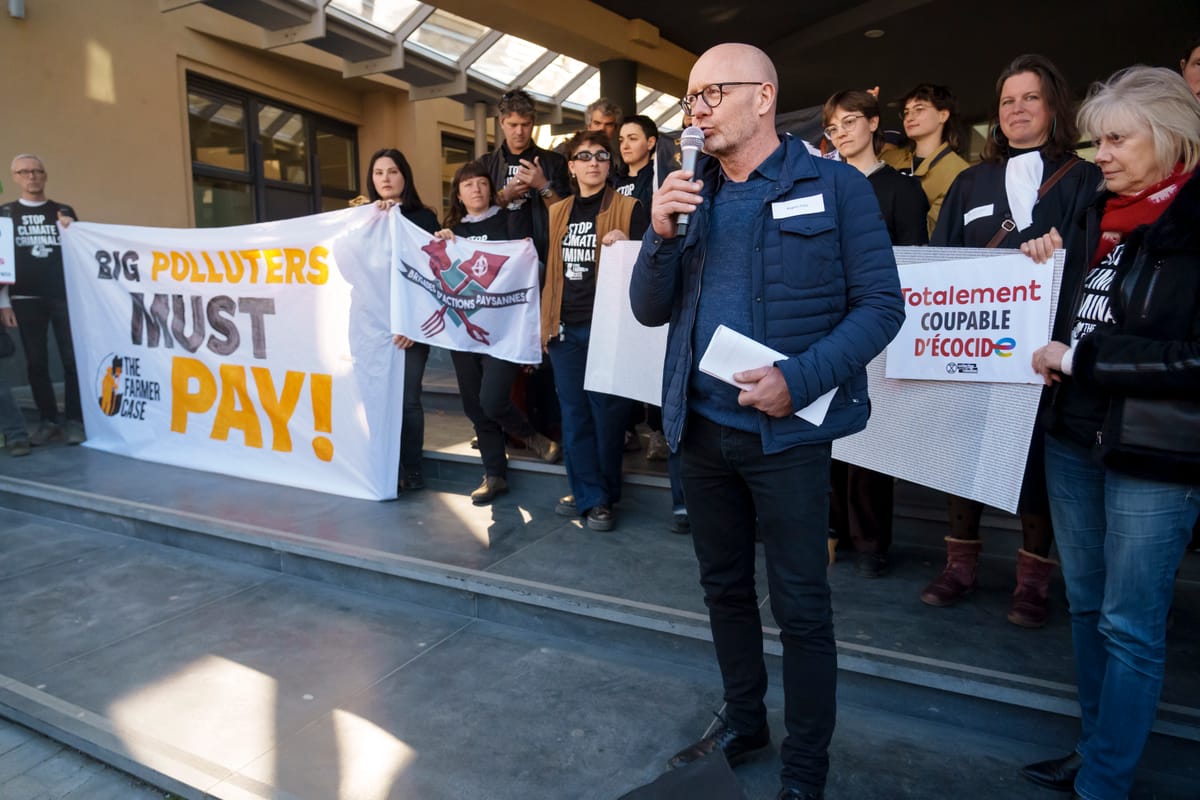
A Belgian court has ruled that a climate accountability lawsuit brought by a smallholder farmer against French oil major TotalEnergies is admissible, a key procedural step forward for the plaintiff Hugues Falys and the NGOs supporting him in his attempt to hold the oil company responsible for its role in fueling the climate crisis. The decision “strengthens climate case law”, the NGOs say, because it recognizes that individuals harmed by climate change can sue a multinational corporation in their home country even if the company is not based there.
Marie Doutrepont, a lawyer representing Falys, called the ruling on admissibility “an important sign of hope.”
“It has been recognized that victims of the climate crisis can take highly polluting companies – which contribute significantly to climate change – to court in their own country, even if that is not where the company is headquartered,” she said in a statement. “This is a landmark ruling.”
Falys along with NGOs FIAN, Greenpeace Belgium, and Human Rights League filed the lawsuit against TotalEnergies in March 2024, seeking to hold the company liable for climate damages under Belgian law and to compel it to align its business activities with the temperature goals of the Paris Climate Agreement. As a farmer in Belgium’s Hainaut province who engages in sustainable farming practices, Falys is already experiencing the damaging impacts of climate change on his agricultural livelihood. Major fossil fuel producers like TotalEnergies, he argues, should bear responsibility for their conduct that contributes to the climate crisis.
Speaking outside the Tournai Commercial Court on Wednesday, Falys said he was encouraged by the court’s recognition of the plight facing farmers due to climate change, which is primarily caused by fossil fuel emissions.
“The court stated that agriculture is directly affected by the climate crisis, that farmers are victims of it – 8 out of 10 farmers in Belgium are suffering from climate breakdown,” Falys said. “It also stressed that the justice system has a role to play in holding those responsible for this crisis to account. Things are changing.”
The lawsuit is the first of its kind in Belgium to take on a multinational corporation over climate change harm. If successful, it could set an important precedent for corporate climate accountability.
The ruling from the court on Wednesday follows hearings held in November and December. The court has decided to hold off on deciding the merits until a court in France issues a verdict in another climate case pending against TotalEnergies. That case, brought by French NGOs and the city of Paris under the French duty of vigilance law, also aims to force the company to cut back on its oil and gas production in order to align with global climate objectives. The Paris Judicial Court will deliver its verdict in that case on June 25.
The Belgian case against TotalEnergies demands that the company immediately cease investments in new fossil fuel projects, reduce its oil and gas production by 47 percent by 2030 and 75 percent by 2040, and slash its greenhouse gas emissions by at least 60 percent by 2030.
The case in France, which was heard by the Paris court in February, makes similar demands. The plaintiff NGOs want the court to order TotalEnergies to stop expanding oil and gas production and to implement a strategy aligned with pathways consistent with limiting long-term temperature rise to 1.5 degrees Celsius, which necessitates phasing out fossil fuels as rapidly as possible.
TotalEnergies says that such demands are impractical. “It makes no sense at all to prevent TotalEnergies [from] producing oil and gas that the global energy system still uses today,” a company spokesperson said in a statement about the lawsuit in France.
The legal team and NGOs supporting Falys in his case against the oil major are hoping that a ruling against Total in the French case will also give rise to victory in their suit, and they expect a decision to come shortly after the Paris court rules on June 25.
“We hope that the final decision will recognize the need for corporate accountability to be a cornerstone of the transition away from fossil fuels,” Alexis Deswaef, President of the International Federation for Human Rights, said in a statement.