Climate Deception Suit Comes To The Supreme Court
A few points to keep in mind as the highest U.S. court hears a landmark climate case.
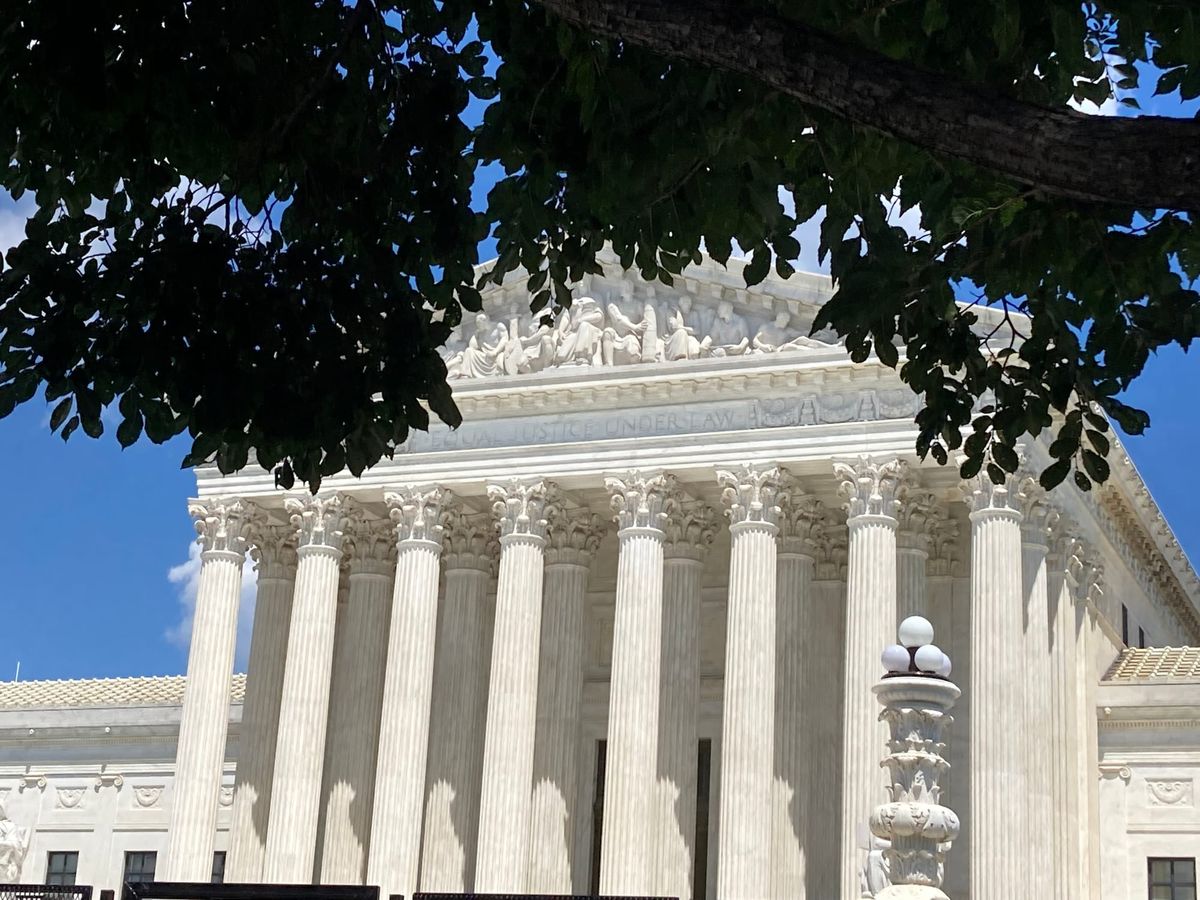
Tomorrow the U.S. Supreme Court opens its fall term with what has been described as a “blockbuster” climate case of potentially enormous significance. It involves state tort law claims brought by the city and county of Boulder, Colorado against oil and gas entities Suncor and ExxonMobil, seeking to recover damages for localized climate change impacts. The oil companies say that federal law, including the Constitution and the Clean Air Act, preempts or overrides Boulder’s state law claims, while Boulder argues that is not the case and the court shouldn’t even be hearing their lawsuit to begin with, as there has been no final judgment or resolution on the merits by the lower courts, and not even a trial.
But this is much bigger than just a dispute between Boulder and major oil companies, with issues of federalism, state sovereignty, and corporate accountability likely at stake in the outcome. The court’s ruling could have implications for the more than two dozen climate deception cases currently pending against the fossil fuel industry in courts around the country. Industry lawyers and the Trump administration’s Department of Justice are certainly hoping for a broad decision from the justices that would knock out all of these lawsuits in one fell swoop.
Their main statutory argument for federal preemption is based on the Clean Air Act and rests on the characterization of Boulder’s lawsuit (and the other suits against the industry) as sweeping attempts to dictate climate policy and regulate greenhouse gas emissions. Since the Clean Air Act exclusively authorizes the Environmental Protection Agency to regulate transboundary air pollution like greenhouse gas emissions, the argument goes, state law has essentially no role to play in matters concerning GHG emissions and climate.
Some experts, however, including legal scholars and former EPA officials under both Democrat and Republican administrations, say that such an argument is just plain wrong. For starters, they note that industry lawyers mischaracterize Boulder’s case and others like it as centered around global GHG emissions rather than corporate fraud and deception. Greenhouse gas emissions may be the mechanism by which harm occurred, but emissions are not the source – the actual source, the tort or wrongdoing, is alleged deception such as misleading marketing, and the Clean Air Act in no way regulates that conduct.
“The law regulates emissions, not fossil-fuel marketing, and it does not displace states’ traditional authority to apply their own tort law to conduct outside its scope,” said William Reilly, who served as EPA Administrator from 1989 to 1993. “Boulder is seeking damages for alleged misconduct, not emissions limits, and it should be allowed to make its case,” former Obama EPA head Gina McCarthy added. Reilly, McCarthy, and other former EPA officials submitted an amicus brief backing Boulder in which they explain why the oil companies’ Clean Air Act arguments are baseless. “Far from vesting the EPA with exclusive federal control over all emissions, the Act expressly provides for a significant state role,” their brief asserts. The Clean Air Act does indeed include savings provisions that expressly preserve a role for state law regulation and remedies.
Further complicating the industry’s Clean Air Act argument is the action taken by the Trump administration to repeal all federal greenhouse gas regulations and rescind the so-called endangerment finding; in doing so, the Trump EPA claims that the Clean Air does not authorize it to control GHG emissions – the opposite of what the oil companies and Trump DOJ are arguing in the Suncor case in insisting there is federal preemption. The contradiction is glaring, and some legal experts have pointed out that the industry and the administration are trying to have it both ways. In other words, they want there to be no federal regulations and also no state actions when it comes to addressing climate harm.
“If both efforts succeed, by the corporations and by the administration, the outcome is no federal regulation, and no state remedy,” said Alejandro Camacho, an environmental law professor at UCLA School of Law. That would leave “this double sort of vacuum,” he noted, resulting in a level of corporate impunity that would be unprecedented.
A broad ruling in favor of the oil companies, experts say, would be extremely consequential. It would likely kill most if not all of the pending climate deception cases against the fossil fuel industry, but it could even go beyond that. As James May, a professor of environmental law at Washburn University, previously told Climate in the Courts, it “could be the beginning of the end of state-based climate claims, potentially of any flavor, statutory, common law, or constitutional.” State climate superfund laws seeking to recover a one-time fixed cost against major fossil fuel producers, for example, could be foreclosed. So too could constitutional climate lawsuits brought by young people against state governments. May says that in his view, this “is the biggest story in environmental law and even beyond that right now.”
That is because the court’s decision, if it endorses the industry’s arguments, may have potentially sweeping repercussions that extend even beyond climate, implicating other types of environmental disputes or cases involving multinational corporations that cause widespread harm.
“That reasoning isn’t just related to climate. It could become a template for arguing that other sorts of transboundary harms – PFAS, plastics, other pollutants that cross state lines – are somehow beyond state tort law,” Camacho said. The foreign affairs doctrine argument offered by the oil companies, he noted, were it to be accepted by the court, could theoretically immunize any multinational corporation whose business or products have international reach. “It’s a rule of corporate immunity from state court accountability,” he said.
A narrower ruling from the court is another possible outcome. Camacho said such a ruling “could leave deception cases standing, but knock out emissions-based counts.” Under that scenario, tort claims like nuisance, negligence, and trespass would be invalidated, but claims brought under state consumer protection statutes could survive. Many of the pending climate lawsuits against the fossil fuel industry bring a mix of state tort claims and statutory consumer fraud claims, and some cases bring only the latter. A case brought by the state of Connecticut against ExxonMobil, for example, is strictly a fraud case, as it only claims violations of the state’s consumer protection statute. This case is moving into pre-trial discovery, and the Second Circuit Court of Appeals has allowed it to move ahead in state court. The Second Circuit is the same court that in 2021 affirmed dismissal of a climate tort case brought by New York City against oil companies – a precedent that industry lawyers have leaned on heavily.
“Even some of the judges who are most skeptical of these kinds of state tort claims related to climate change have started to draw a line when it comes to something that’s characterized more as fraud,” Rachel Rothschild, a University of Michigan assistant law professor, said during a recent webinar.
Massachusetts has a consumer fraud case against Exxon, very similar to Connecticut’s case, which is already deep into discovery and could be one of the first cases to make it to trial. And speaking of trial, another thing to keep in mind is that there was a case brought by the state of New York against Exxon alleging securities fraud (that Exxon misled investors in its climate communications) that went to trial back in 2019, and Exxon actually prevailed there. So, allowing lawsuits to go to trial does not guarantee that the plaintiffs will win. The oil companies could still come out on top, either at trial or in subsequent appeals.
What the Suncor v. Boulder case is really about, then, is whether or not plaintiffs should even get a chance to present their case at trial.
“One of the things that’s important about these cases, apart from the outcome, is the right to have a trial on the deceptive practices of the oil companies,” said Dan Farber, professor of law at University of California Berkeley School of Law. “How they were allegedly conning the American public when they actually knew that climate change was real, was harmful, and that their products were a major source.”