Courts In Alaska And California Hear Appeals In Youth Constitutional Climate Challenges
Youth climate activists fighting a fossil fuel megaproject in Alaska and challenging an allegedly discriminatory federal regulatory practice came before appellate courts this week urging that the dismissals of their cases be overturned and that they be allowed to present their arguments and evidence at trial.
On Wednesday, the Alaska Supreme Court heard oral arguments in the case Sagoonick v. State of Alaska II – a case brought by eight young Alaskans against their state government over a statute requiring development of a large fossil gas project on Alaska’s North Slope called the Alaska LNG Project. Youth plaintiffs argue that because the project would unleash substantial levels of greenhouse gas emissions that worsen the climate emergency, the state law mandating its development violates their public trust and due process rights under the Alaskan constitution. Last year the trial court dismissed the case, finding plaintiffs’ claims were barred by the political question doctrine. Now, it is up to the state supreme court to decide whether or not the case will be revived.
At the same time, the Ninth Circuit Court of Appeals will be determining whether to reinstate claims brought by 18 young people from across the state of California against the US Environmental Protection Agency, in a case alleging that the agency’s practice of discounting future benefits and value in regulatory cost-benefit analyses discriminates against children. That case, Genesis B. v. EPA, was also tossed out by a lower court last year and is currently pending on appeal. A panel of the Ninth Circuit Court heard the case on Thursday.
In Alaska: “The courthouse doors must remain open”
In the Alaska case, the youth plaintiffs are attempting to stop what they and their lawyers say is “one of the largest fossil fuel projects ever proposed on Earth,” a massive new gas extraction and export project that is expected to result in over 2 billion metric tons of climate pollution over 30 years, roughly tripling Alaska’s greenhouse gas emissions at a time when scientists say such emissions must rapidly decline in order to avoid catastrophic and irreversible damage.
“The Alaska LNG Project would commit the state to decades of drastic fossil fuel expansion, locking in worsening flooding, storms, and wildfires in these young peoples’ communities and driving worsening species population declines, collapses, and extinctions of the fish and wildlife they depend on for subsistence,” Andrew Welle, lead attorney for the youth plaintiffs, said in a statement.
Welle told the Alaska Supreme Court that the project would unleash “colossal’ levels of emissions that will harm the state’s youth for decades to come. But before the courts can get to the merits, they have to determine if the case is even justiciable – and this, Welle said, is where the trial court got it wrong.
“Important questions regarding climate change mitigation do not present justiciable questions because the Court lacks both the authority and the tools to reweigh the competing economic, environmental, social or conservation goals served by the legislature’s policy choice to enact the challenged statute or advance the Alaska LNG Project,” Alaska Superior Court Judge Dani R. Crosby wrote in her opinion dismissing the case.
Welle argued that this is not a dispute over a policy disagreement and that state laws concerning natural resource management are not exempt from constitutional scrutiny.
“For the separation of powers to have any meaning, the courthouse doors must remain open to these youth,” he told the court.
The state, meanwhile, urged the court to uphold Crosby’s ruling, saying that the plaintiffs were once again asking courts to second-guess the decisions made by the state legislature. Laura Wolff, an attorney for the state, told the justices that plaintiffs’ concerns are not “unimportant,” but that they must be directed towards the elected branches of government.
Wolff also argued that plaintiffs’ allegations of harm are too speculative. She contended that climate change impacts “cannot be tied to any particular emissions source,” and any emissions resulting from the Alaska LNG project would be a drop in the bucket on a global scale.
Welle pushed back against this argument, asserting that Alaska’s greenhouse gas emissions “are not globally insignificant” and are actually on par with emissions from some entire countries. The state’s skepticism about the veracity of plaintiffs’ allegations, he said, only “highlights the controversy,” which would benefit from the full development of a factual record.
At the end of the hearing, the court said that it would take the matter under advisement and issue a decision at a later time.
In California: “Our futures are not for sale”
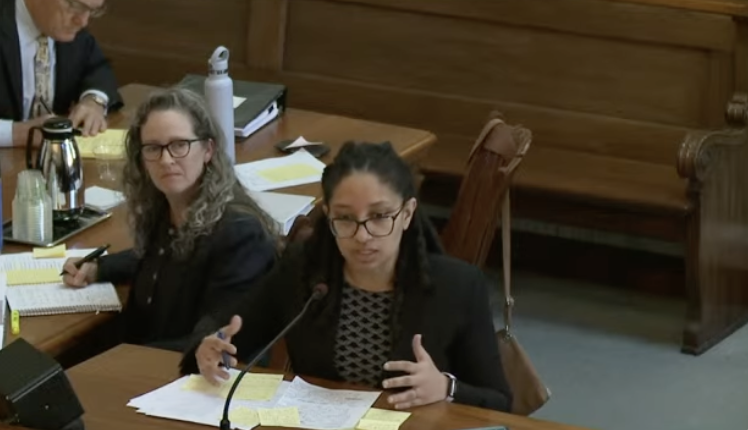
In the Genesis case, argued before a three-judge panel of the Ninth Circuit Court of Appeals in San Francisco, California on Thursday, an attorney representing the youth plaintiffs was pressed by the court on how the EPA’s discounting practice is discriminatory towards children.
The case alleges that this policy, which informs cost-benefit analyses used in regulatory decision-making, devalues the lives and interests of children since it places lower value on future effects than on present ones, and that the EPA therefore discriminates against children in allowing unsafe levels of climate pollution. Plaintiffs say this violates their equal protection rights under the US Constitution.
EPA’s regulatory programs established under its discounting policies have “resulted in allowing climate pollution in substantial amounts,” Brianna Rosier Kabwika, staff attorney at Our Children’s Trust and counsel for the youth plaintiffs, told the court.
Christopher Anderson, an attorney representing the government defendants, argued that the plaintiffs lack standing because they cannot establish a causal connection between the challenged discounting practice and concrete harms from climate change. He said there would have to be a specific regulatory action or decision to point to, one that was both based upon the discounting practice and that has led to the alleged harms, for there to be traceability established, which is a requirement for standing.
At least one of the three judges on the panel seemed to agree with Anderson’s point about the difficulty in establishing causation. Judge Milan Smith Jr. at one point said he was “troubled” by the speculative nature of the allegations.
The panel, which overall appeared more skeptical towards the plaintiffs’ case, will issue its decision at a later time.
Speaking outside the San Francisco courthouse following the hearing, the youth plaintiffs and their attorneys insisted that they will continue fighting for justice.
“We’ve seen the EPA continue to prioritize corporate greed over the health and livelihoods of its people,” said Maya W., a plaintiff and current sophomore at UC Berkeley. “We are here to show the EPA that our lives, our health, and our futures are not for sale, and we will keep fighting to defend our constitutional rights.”
“It is the very definition of discrimination to hurt children’s bodies while giving more money to adults today,” said Julia Olson, co-executive director at Our Children’s Trust. “We’re going to keep going no matter what happens.”