Big Oil And Boulder, Colorado Face Off At US Supreme Court
Some justices seemed skeptical of oil companies’ broad constitutional arguments.
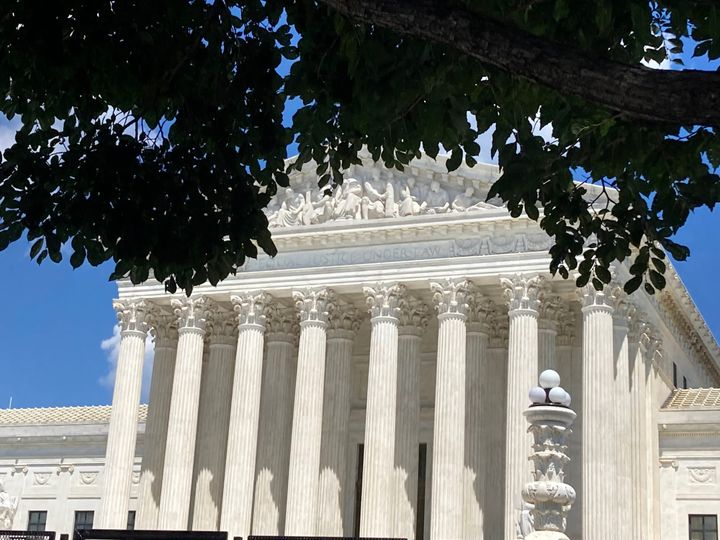
The U.S. Supreme Court opened its new term on Monday with oral arguments in a case called Suncor v. Commissioners of Boulder County, which concerns a climate change tort lawsuit brought in 2018 by the city and county of Boulder, Colorado against oil companies ExxonMobil and Suncor. The lawsuit is still in early stages and has not made it to trial, but the Supreme Court’s decision could determine whether Boulder’s lawsuit and dozens of others like it pending in state courts across the country are allowed to proceed at all.
Exxon and Suncor argue that federal law broadly prohibits Boulder from suing them under state law theories like nuisance and trespass for localized climate harms stemming from global greenhouse gas emissions. The Constitution itself as well as the federal Clean Air Act bar Boulder’s state law claims, the companies say. The Trump administration, which also argued before the court on Monday, is backing the industry’s position.
Kannon Shanmugam, counsel for ExxonMobil who argued on behalf of oil company petitioners, led with what legal experts say is a far-fetched constitutional argument – that the Constitution’s structure prevents individual states from regulating or suing over conduct occurring beyond their borders even if it causes harm in that state. “As a matter of constitutional structure, federal law and only federal law can apply,” Shanmugam said in response to a question from Justice Neil Gorsuch about the extent of this extraterritoriality principle in the context of greenhouse gas pollution.
Some justices expressed skepticism towards the broad constitutional arguments offered by the oil companies and the Department of Justice. In response to the assertion that states cannot regulate in the area of air and water pollution because of some constitutional principle, Justice Elena Kagan asked: “Where’s the text for that, where’s the support for that? Where’s the precedent for that?” Justice Ketanji Brown Jackson said that the extraterritoriality principle seems “very close to a causation test” that could be sorted out through the course of fact finding in state court. Even Chief Justice John Roberts raised the point that there are many instances where there are harms caused by out-of-state conduct that can be redressed through tort litigation. “Conduct that could have impacts in many states, all of the states, we still allow, in many of these situations, people to file in their state to seek relief from injuries that are occurring in their state,” Roberts said.
“The companies' broadest theory had a bad day,” Alejandro Camacho, an environmental law professor at UCLA School of Law, told Climate in the Courts. “Several justices across the spectrum resisted the idea that the Constitution's structure alone bars state climate suits.”
“[Kagan] is not buying the constitutional preemption pitch; nor is [Sonia] Sotomayor or Jackson. The others are hard to read,” said Pat Parenteau, emeritus professor of law at Vermont Law and Graduate School.
In characterizing Boulder’s lawsuit as an attempt to regulate greenhouse gas emissions, the oil companies also argue that the Clean Air Act preempts or overrides Boulder’s state law case.
Kevin Russell, an attorney who argued on behalf of Boulder, tried to distinguish the lawsuit as being more about fraud or deception rather than pollution. “This case is not about emissions. It’s about deception and about producers,” Russell said.
A lot of the discussion and questioning, however, centered around the framing of Boulder’s case as an interstate pollution dispute. Justice Brett Kavanaugh on several occasions pointed to the court’s precedents in cases involving air and water pollution, suggesting that Boulder is running into a “wall of precedents” limiting the role of states in those types of interstate pollution conflicts. Justice Kagan even at one point suggested that Boulder’s theory of liability and injury seems predicated on the “idea that defendants are responsible for excessive emissions.” But earlier on in the arguments, Kagan did note that Boulder’s case brings deception and misrepresentation claims, similar to litigation against tobacco or opioid manufacturers.
The question about the EPA’s authority to regulate greenhouse emissions, given the agency’s recent disavowal of that authority, came up, but it wasn’t a major point of discussion.
What seemed to be a more important question for the justices was whether or not they have jurisdiction to decide the case at this time. Federal procedural rules generally limit the court to hearing only cases that have had a final resolution in lower or state courts. Boulder has argued that its case is still in early stages with no final judgment by the state court.
Justice Jackson raised that point in questioning Shanmugam. “We’re really early in this case,” Jackson said. “Why shouldn’t we wait and hear all of these claims once the state courts are done with their considerations?”
Shanmugam responded by noting that oil companies are now facing dozens of lawsuits from state and local governments across the country, including one filed just last week, that are seeking billions of dollars in damages, and that the threshold question of whether they should even be allowed needs an urgent answer.
Shanmugam further acknowledged, in responding to a question from Justice Sotomayor about how the oil companies are injured at this point in the litigation, that their only harm is being forced to continue spending money on legal fees. Sotomayor did not seem sympathetic to that purported harm.
And it was not just the liberal justices who brought up the jurisdiction issue. Justice Clarence Thomas also raised this question with both parties. If the court decides it does not have jurisdiction at this time, Boulder would then be allowed to proceed with its case in Colorado state court.
Camacho said that dismissal for lack of jurisdiction, or even a split 4-4 ruling, could be a plausible outcome. Justice Samuel Alito, who was expected to be a reliable vote in favor of the oil companies and who holds stock in ConocoPhillips and Phillips 66, recused himself one week before the oral arguments.
A decision from the court is expected sometime in 2027.
“Big Oil’s desperation to escape trial for climate deception is still in search of a legal justification,” Corey Riday-White, legal director of the Center for Climate Integrity, an organization that supports efforts to hold climate polluters accountable, said in response to Monday’s hearing. “Justices across the ideological spectrum asked good, skeptical questions that poked holes in Big Oil’s attempt to stop Boulder’s case before it can go to trial.”
“We Deserve Our Day in Court”
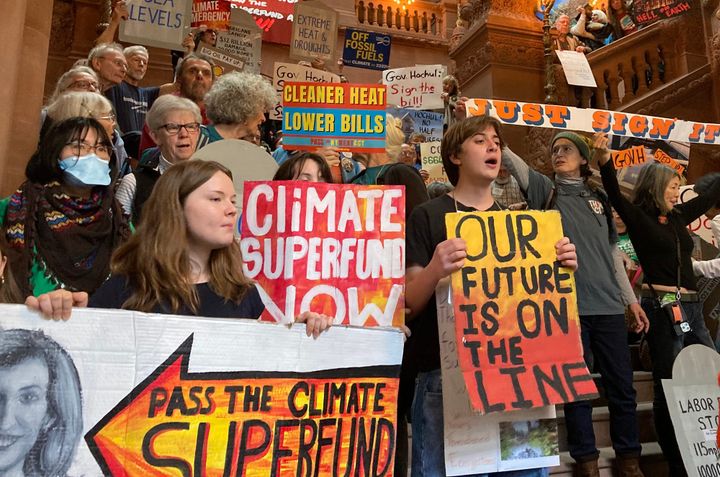
Before the oral arguments kicked off, supporters of Boulder’s case and of climate accountability initiatives in general gathered outside the court for a rally, dubbed “The People v. Big Oil.” The gathering featured short speeches from wildfire survivors, Colorado ranchers, Boulder County youth, and climate accountability advocates, who explained why this lawsuit matters.
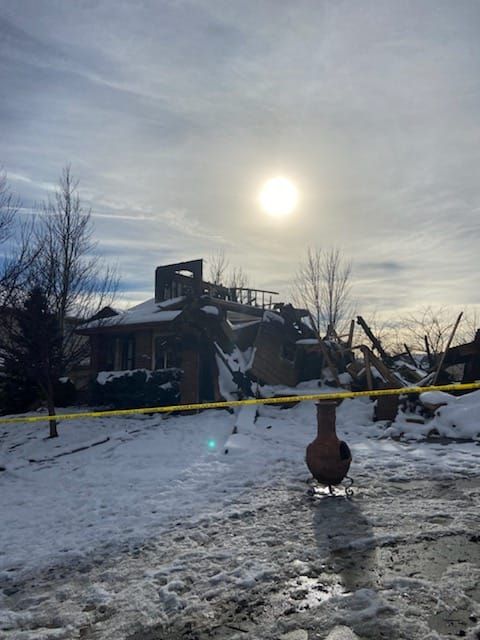
“It is profoundly unfair that oil companies keep the profits while me and my neighbors are left with the losses and the cost of adapting. After everything my community has been through, we deserve our day in court,” said Tawnya Somauroo, a Marshall Fire survivor and cofounder of the community-based group Marshall Together.
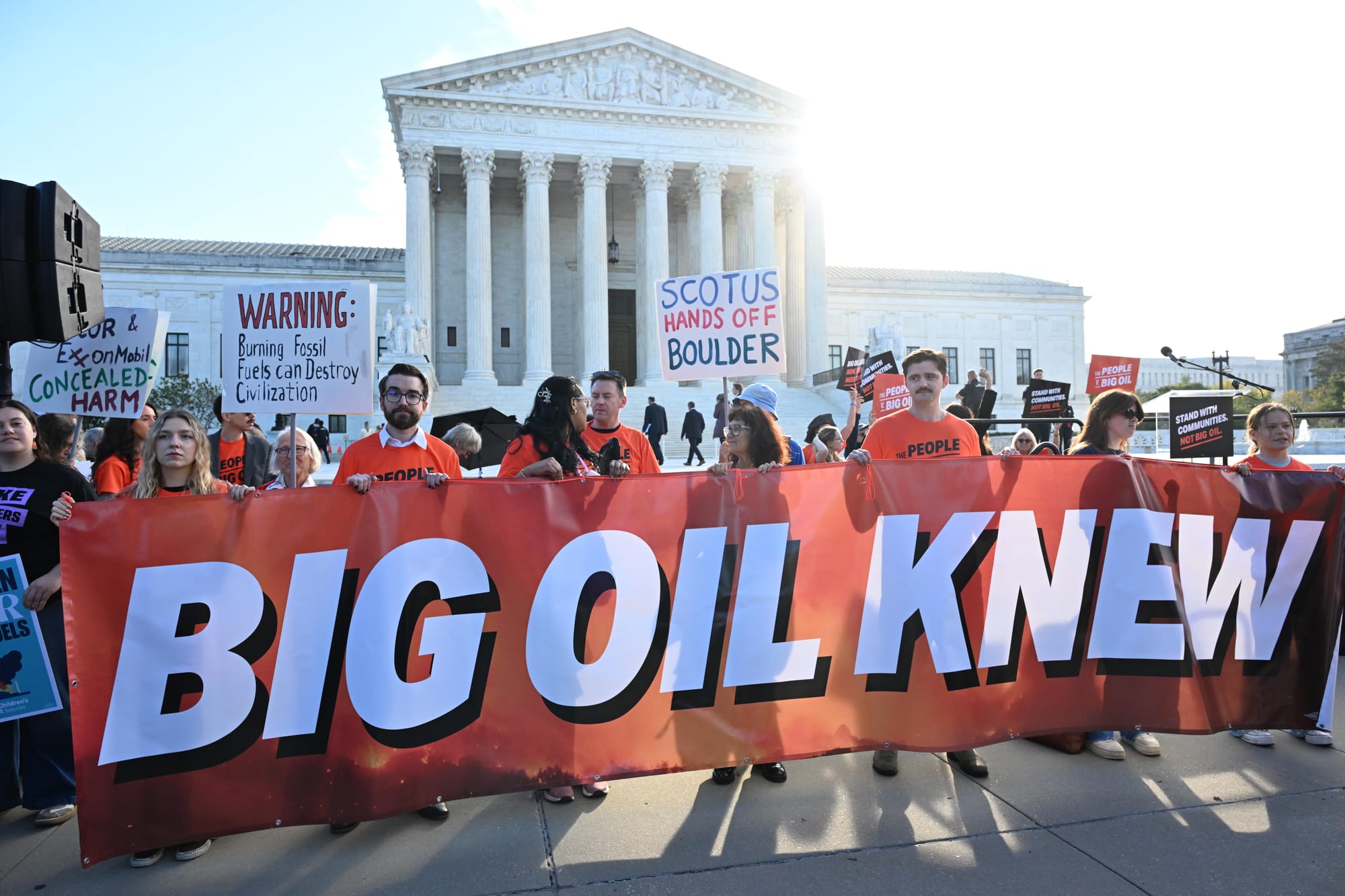
“The fossil fuel industry malignantly and maliciously lied to the American people, and I’ll be damned if I let them take away an American right to hold industries accountable and have their day in court,” said former Washington Governor Jay Inslee, a leading spokesperson opposing the fossil fuel industry’s push to gain legal immunity from accountability for causing climate change. “They knew for decades what the consequences of their products were and they chose to lie. This lie is enormous in scope, it is extensive in duration, and it is fatal in application.”
Cassidy DiPaola, communications director at Fossil Free Media, which co-hosted the rally along with the Center for Climate Integrity, said that the climate crisis was far from inevitable. “Decades ago, before I was even born, Exxon and other fossil fuel companies knew that their products would cause catastrophic climate damages,” she said. “But they lied to the public to protect their profits. As a result, they stole a generation’s worth of time to act.”