Court Advances Pari Islanders’ Climate Case Against Holcim In Switzerland
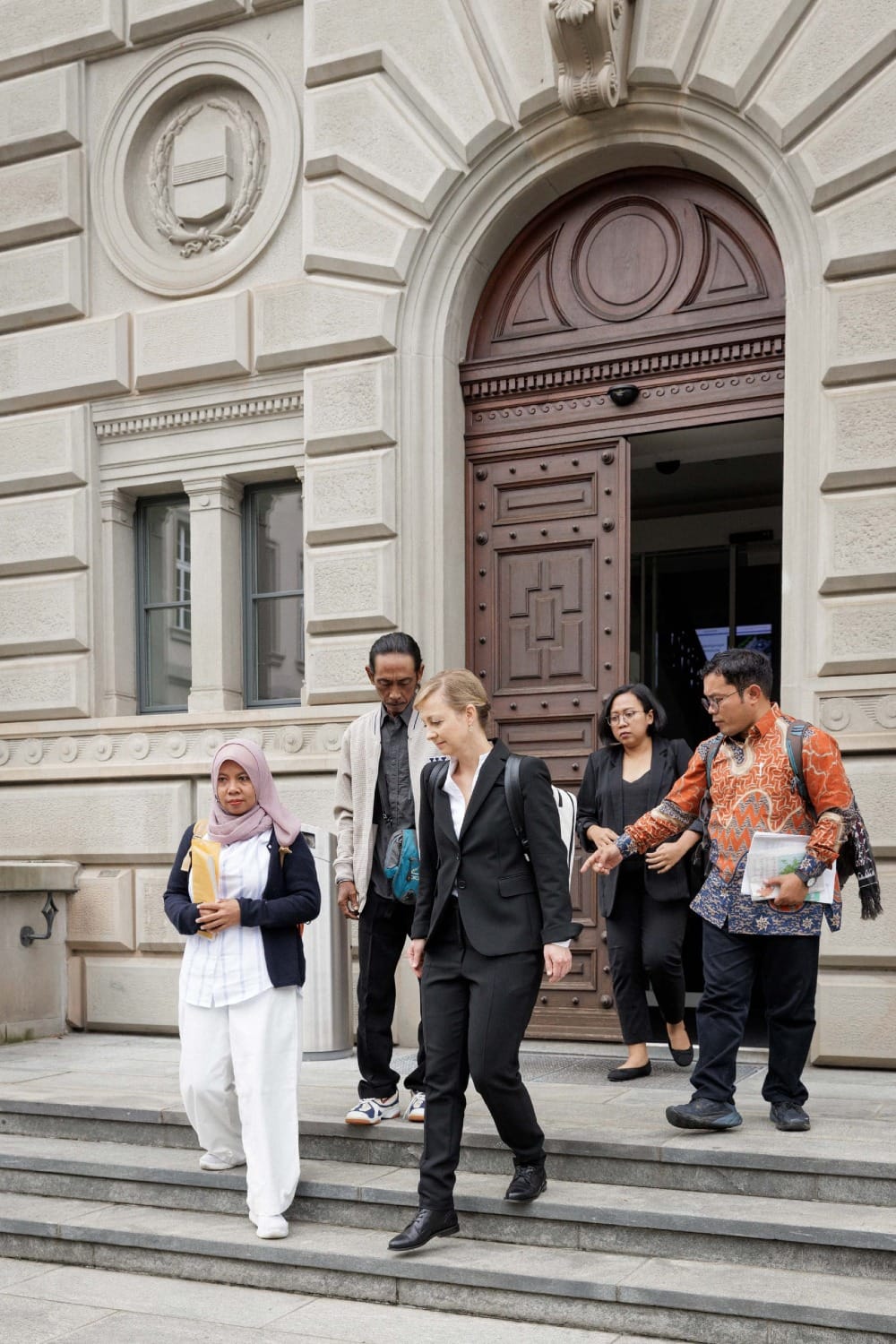
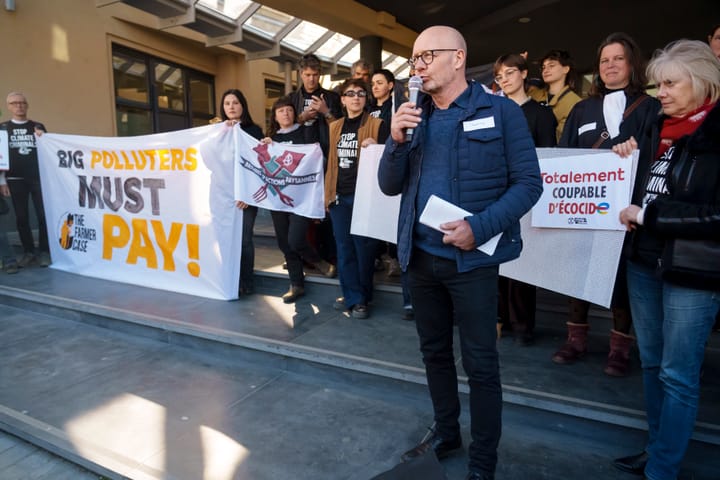
A Swiss court has decided to allow a climate lawsuit brought by four Indonesian islanders against the cement giant Holcim to move forward and be examined on the merits. The decision rejecting the company’s initial procedural arguments means that the plaintiffs are a significant step closer in their pursuit of climate justice, and signals that courts are increasingly willing to accept cases aiming to hold corporate climate polluters accountable.
Following a September hearing in Asmania et al. v. Holcim, the Cantonal Court of Zug made public its ruling today on the procedural question of admissibility. The court determined the case should be admitted in its entirety.
“This is good news for us and our families,” Ibu Asmania, lead plaintiff in the case, said in a statement reacting to the ruling. “This decision gives us the strength to continue our fight.”
Asmania along with three other residents of Pari Island, Indonesia filed a complaint against Holcim in 2023, seeking financial compensation for climate-related loss and damage and an order for the company to rapidly reduce its greenhouse gas emissions. Holcim, headquartered in Switzerland, is one of the largest cement manufacturers in the world and is considered to be one of the carbon majors – 180 fossil fuel and cement companies that are responsible for generating a majority of the carbon emissions that are driving global warming.
As a small, low-lying island, Pari Island is particularly vulnerable to climate impacts like flooding and sea level rise. Climate-induced flooding is already affecting fishing and tourism business on the island, concretely damaging the livelihoods of the four plaintiffs. With their lawsuit, they are aiming to hold Holcim liable for its contributions to global greenhouse gas emissions. They allege violations of their personal rights under Swiss law, and demand that Holcim reduce its emissions at least 43 percent by 2030 and pay compensation for damages as well as contribute to adaptation costs on Pari Island.
Holcim had asserted several arguments in attempting to have the case tossed out. The company said that courts are not competent to handle issues around climate, as it involves political considerations that must be left to the elected branches of government. But the court rejected that defense, writing: “Court decisions do not (replace) democratically legitimised (...) climate protection policy but complement it.” Holcim also argued that it should not be held solely responsible and that the plaintiffs are not uniquely harmed, since climate change impacts everyone to some degree. The court, however, was not persuaded by those arguments. The ruling clarified that “every single [mitigation] contribution is essential for counteracting climate change” and that “harmful behaviour [is] not legitimate because others behave in the same way.”
According to a press release from Swiss Church Aid (HEKS/EPER) and the European Center for Constitutional and Human Rights, which are supporting the Pari Islanders in their landmark climate lawsuit, the ruling is not yet final and can be appealed to the High Court of the Canton of Zug. “However,” the organizations say, “it confirms this development and makes it more difficult for large emitters to avoid having their climate responsibility examined by means of procedural objections. The ruling is therefore an important step towards greater climate justice.”
Holcim said it intends to appeal the ruling.
“We acknowledge the court’s decision on the admissibility of the case,” the company said in a statement. “Holcim remains convinced that the courtroom is not the appropriate forum to address the global challenge of climate change, and that the question of who is allowed to emit how much CO₂ is a matter for the legislature and not a question for a civil court.”
The case is the first of its kind brought against a major emitter in Switzerland, but it is part of a larger wave of global climate litigation seeking accountability from governments and corporations. And courts around the world are not only recognizing the legal relevance of climate change – in some cases, they are handing down decisions that help advance accountability and clarify that climate action is a legal duty.
The European Court of Human Rights issued a groundbreaking ruling in 2024 in a case brought by elder Swiss women finding that the Swiss government’s insufficient climate policies constituted a breach of its obligations under European human rights law. In July this year the Inter-American Court of Human Rights delivered a similarly groundbreaking advisory opinion finding that climate change is a human rights emergency and recognizing, for the first time at the international level, the right to a heathy climate system. Just weeks later the International Court of Justice handed down its own historic advisory opinion on climate change, which suggested that continued support of fossil fuel activities could constitute an internationally wrongful act. And in May a German court affirmed the principle, in the case Lliuya v. RWE, that large carbon emitters could be held responsible for climate damages.
The German case against RWE also opened the door to the possibility of transnational climate liability, in which a polluter based in one country is held responsible for climate damages elsewhere, especially in the Global South. While the Lliuya case, brought by a Peruvian farmer and mountain guide against German energy utility RWE, was ultimately dismissed because the evidence of flood risk to the plaintiff’s home was not strong enough, the German court in Hamm still accepted the case and agreed to examine it on the merits.
Now, several new cases are underway hoping to build upon this foundation. In addition to the Pari Islanders case against Holcim, survivors of Typhoon Odette in the Philippines have just filed a climate damages lawsuit against Shell in the UK, while Pakistani farmers who suffered from the devasting flooding event in 2022 are preparing to bring a claim for damages against RWE and cement company Heidelberg Materials in Germany.