Youth, Doctors and Environmental Advocates Sue Canada Over Climate Policy Rollbacks
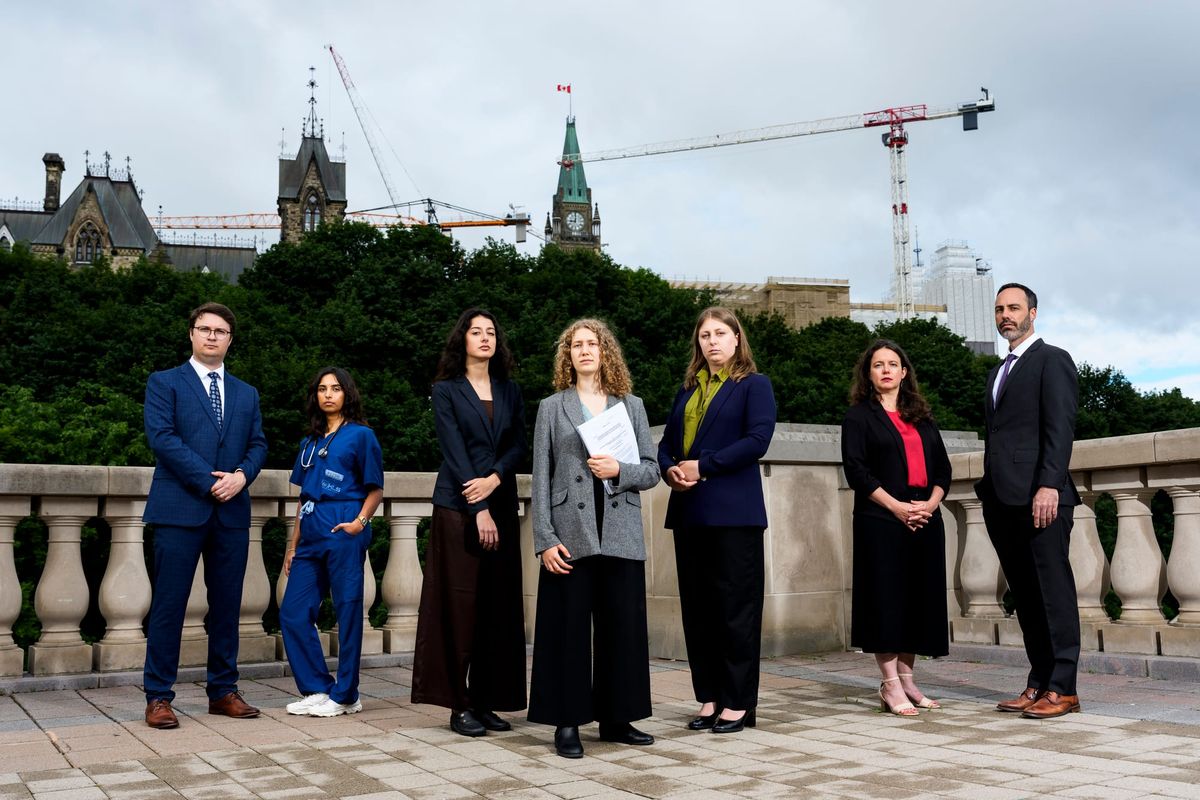
Three young Canadians along with public health and environmental organizations are suing the Canadian government for failing to take actions to achieve a legally binding 2030 greenhouse gas emissions reduction target, alleging that a suite of recent climate policy rollbacks under the government of Prime Minister Mark Carney violate the Canadian Net-Zero Emissions Accountability Act.
The case, filed June 15 in federal court in Ottawa, argues that the government no longer has a legitimate plan to meet the 2030 target, which aims to slash emissions by 40 to 45 percent below 2005 levels. The emissions reduction plan released in 2022, according to the suit, has not been updated to reflect recent actions that weaken environmental protections and favor the fossil fuel industry.
Applicants want the court to order the government to revise its plan so that it complies with the 2021 emissions accountability law, which established the 2030 target and requires a credible plan and periodic progress reporting to ensure the target will be met. The government’s latest progress report at the end of 2025 indicated that Canada was on track to reduce emissions by 21 to 28 percent by 2030 – far below the 40 percent mandated by the law.
“You cannot abandon the map and still expect to reach your destination. Yet that’s exactly what the federal government has done with its 2030 climate plan. Right now, its only climate plan is a plan to fail — and that’s not just irresponsible, it’s unlawful under the Canadian Net-Zero Emissions Accountability Act,” Charlie Hatt, climate director at the nonprofit law firm Ecojustice, said in a statement. Ecojustice filed the case on behalf of youth applicants Marie Maltais, Sophia Mathur, and Shirley Barnea as well as public interest groups Environmental Defence Canada and the Canadian Association of Physicians for the Environment.
The filing lists the Minister of Environment, Climate Change and Nature and Canada’s Attorney General as respondents.
“The Minister's failure to bring the 2030 [emissions reduction plan] into compliance with the Act frustrates key purposes of [the Act], including promoting transparency, accountability and immediate and ambitious action to achieving the 2030 target, as well as achieving Canada's international commitments in respect of mitigating climate change,” the complaint asserts.
Keean Nembhard, press secretary for the Minister of the Environment, Climate Change and Nature, said in a statement: “The government of Canada is committed to fighting climate change and reaching net-zero emissions by 2050. We will continue working to build a clean, low-carbon and resilient country. As this matter is before the courts, we cannot comment further.”
During a press conference on Tuesday, 19-year-old applicant Sophia Mathur of Sudbury, Ontario said that young people are fed up with empty promises and hollow commitments that are not backed by concrete action.
“For my entire life, governments have told young people that climate action is a priority,” she said. “When political leaders say they are committed to climate action while dismantling the very policies needed to achieve it, young people notice. Because we are the ones who will be facing and living with the consequences.”
“I’m here because my future deserves more than a promise,” Mathur added. “It deserves a plan.”
Recent Rollbacks
The lawsuit points to actions taken by the federal government under Prime Minister Carney over the last year that roll back measures meant to reduce GHG emissions and that facilitate further fossil fuel development. They include actions like scrapping consumer carbon pricing and the electric vehicle sales mandate, weakening methane regulations and suspending clean electricity regulations, reversing implementation of a cap on oil and gas industry emissions, pledging support for new pipelines and other fossil fuel infrastructure, and doubling down on subsidies and fast-tracking of oil and gas projects.
“The Prime Minister has taken a wrecking ball to our hard-fought climate progress. He has gutted environmental protections, given free rein to polluters, and ended programs that would allow Canadians to save money on their energy bills,” said Julia Levin, associate director of Environmental Defence’s national climate program. She drew a comparison to the dismantling of climate and environmental protections in the United States under President Donald Trump, arguing that Carney is “copying President Trump’s short-sighted and destructive playbook.”
“Under Prime Minister Mark Carney, we have seen a sweeping dismantling of climate policy without a credible plan to reduce emissions and meet Canada’s 2030 climate target,” Samantha Green, a family doctor in Toronto and board president of the Canadian Association of Physicians for the Environment, said during the press conference. “These decisions benefit oil and gas billionaires, and they put the health and safety of everyday citizens at risk.”
The applicants and their attorneys say that the case does not aim to dictate government climate policy. Under their demands, the government would still have discretion to set whatever policies they choose, but their policies would need to be subject to public input and they would ultimately need to be aligned with the 2030 climate target.
“The idea with this lawsuit is not to tell the government you must put in place this measure or that measure. The idea is to say you have to have measures that collectively allow you to meet the 2030 target. And the government’s own reporting has shown that under current policies, that’s not possible,” Shirley Barnea, youth applicant from Montreal, explained.
In a recent letter to Environment Minister Julie Dabrusin, the Senate Committee on Energy, the Environment and Natural Resources pointed out that Canada is not on track to meet its 2030 climate target and urged the minister to do more to close the gap.
Other Climate Cases in Canada Moving Forward
Hatt of Ecojustice said that this case marks “the first time that the federal climate accountability law is going to be interpreted by the Federal Court.”
“We see this as a key opportunity to hold the government accountable to its commitments and to its duties under the law,” he said.
Ecojustice is also representing young people, including Mathur, in a climate lawsuit challenging the Ontario government’s climate rollbacks. That case is still proceeding through the courts.
Another youth lawsuit against Canada’s federal government, called La Rose v. His Majesty the King, claims that the Canadian Net-Zero Emissions Accountability Act and the 2030 plan are inconsistent with an emissions reduction trajectory informed by the best available science and that these policies thus violate plaintiffs’ rights to life, liberty and security of the person under section 7 of the Canadian Charter of Rights and Freedoms. That case is scheduled to go to trial in Vancouver starting on October 26.