Ugandan Farmers File Lawsuit In The UK Seeking To Stop East African Crude Oil Pipeline
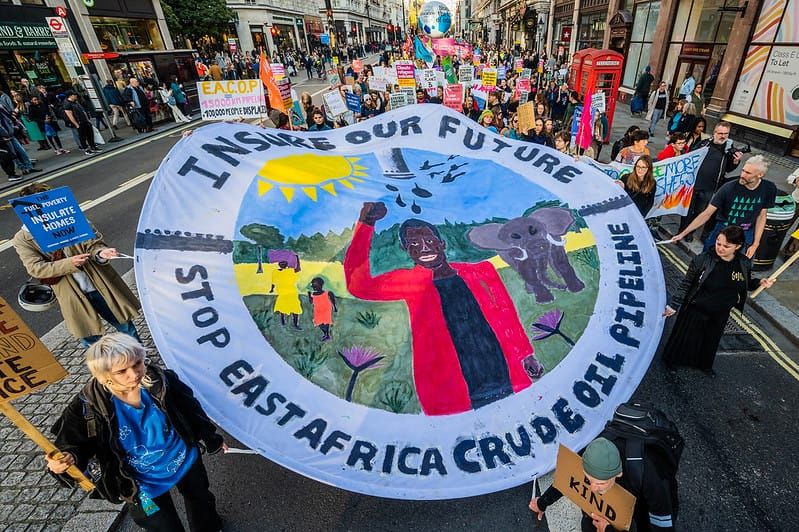
A landmark lawsuit was filed this week in the UK that aims to block the controversial East African Crude Oil Pipeline from becoming operational. The case, brought by four Ugandan farmers adversely impacted by the oil megaproject, seeks to apply Ugandan constitutional, climate, and environmental law against the UK-registered company that is developing the nearly 900-mile-long pipeline, the longest heated oil pipeline in the world.
“It’s believed that it is the first time that Ugandan climate and environmental law has been brought before a foreign court,” Bieta Andemariam of the global campaign organization Avaaz, told reporters during a Tuesday press briefing.
The lawsuit was filed on Tuesday at the High Court of Justice in London. It targets EACOP Ltd, a special purpose company registered in the UK that was established in 2022 to construct and operate the East African Crude Oil Pipeline. French oil major TotalEnergies controls 62 percent of the company. Uganda National Oil Company, Tanzania Petroleum Development Corporation, and China National Offshore Oil Corporation all have smaller ownership stakes.
EACOP, as the pipeline is known, would carry crude oil from Ugandan oil fields near Lake Albert to the port of Tanga in Tanzania for shipment to world markets. At peak capacity it could transport up to 246,000 barrels of oil a day.
That oil, once combusted, would emit significant amounts of planet-heating greenhouse gases at a time when scientists warn the world faces a serious climate emergency.
“Once the pipeline becomes operational, it will enable a huge quantity of greenhouse gas emissions to be released into the atmosphere, worsening an already critical global crisis,” said Marc Willers KC, barrister at Garden Court Chambers in London and legal adviser on the case.
The pipeline route crosses through ecologically sensitive areas like wetlands, protected habitats, and the Lake Victoria basin – a critical water source for around 40 million people. “More than 100,000 people in Uganda and Tanzania have been affected by land acquisition linked to EACOP, including families who have lost homes, farmland, access to land or livelihoods,” a press release announcing the new lawsuit states.
Samuel Abedilembe, a farmer and claimant from Uganda’s Hoima district, has lost 42 percent of his land to the project. “I now have less land to cultivate and less food to support my family,” he said.
Rachael Tugume, another claimant and Ugandan farmer, has been displaced from her land by the EACOP project. She said she is concerned about oil spills contaminating the soil and water sources, as well as climate impacts like severe droughts that are already making farming more difficult. “What EACOP is doing is not good for our communities,” she said.
The lawsuit argues that the pipeline’s construction and operation violates Ugandan law, including the country’s National Climate Change Act 2021, National Environment Act 2019, and constitutional provisions guaranteeing the right to a clean and healthy environment.
“EACOP Ltd is a UK-registered company behind a pipeline with the potential to cause devastation in Uganda and beyond,” said Matthew Renshaw, a partner at Leigh Day, the law firm leading the case. “Our clients are bringing this claim under Ugandan law, which allows individuals to seek relief where a company’s actions threaten efforts to adapt to or mitigate climate change. They believe EACOP is a stark example of that risk.”
Renshaw said there are multiple precedents suggesting that a case like this can succeed, whereby UK courts have held corporations accountable that have caused harm elsewhere in the world. Last year the High Court ruled that Shell should have to face a full trial over its legacy oil pollution in Nigeria, for example.
Although the pipeline construction is now more than 90 percent complete, the legal challenge aims to stop the oil from flowing. Should the pipeline become operational within a few months or while the case remains pending, claimants are requesting a court order that would halt operations.
“What makes this case unique and important is that it brings together corporate accountability and prevention,” said Joana Setzer, associate professorial research fellow at LSE’s Grantham Research Institute and a leading expert on climate litigation. “The timing is critical: it is being brought before the harm occurs. It asks whether courts can act before a spill, before the emissions, and before the damage is done.”